
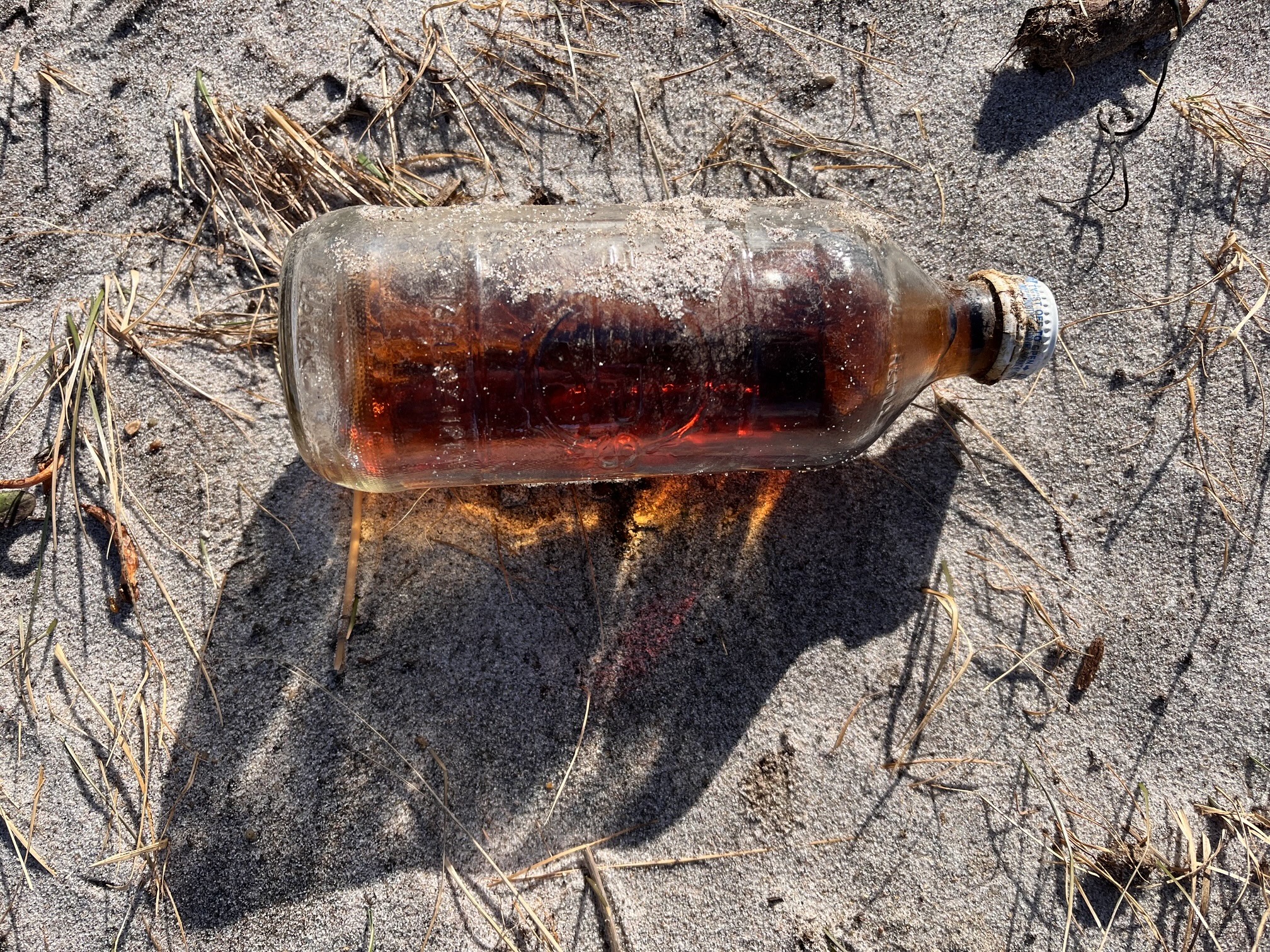
An old Pepsi bottle appears on a storm-wracked beach. Where (and when) did it come from? And what can it tell us about the future of the coastline in an era of climate change and rising sea levels?
Links
Will Kochtitzky’s study of beach erosion caused by the January 2024 storms
Transcript
[BRINY THEME MUSIC]
This is the Briny. I’m Matt Frassica.
If you listen all the way through the credits–which I’m sure you do!–you know this show is part of Hub & Spoke, a collective of independent podcast producers.
Well, Hub & Spoke recently added a new member show: Audio Flux, which is a home for short-form audio experimentation. Every few months, they put out a call for entries with a set of prompts, like “make a pet your protagonist” or “include the sound of time passing.”
For their most recent set of prompts, they asked for 3-minute stories about climate change, inspired by a found object.
That made me think back to something I found on the beach a couple of years ago.
And I did make a 3-minute “fluxwork” and send it in. But doing that just made me more curious about that thing I found.
So I decided to do some digging. The result is the episode you’re about to hear: it’s very simple, and it’s in two parts.
Part one [chime]. The object.
One of my favorite places in Maine is Crescent Beach state park, in Cape Elizabeth.
It’s a beautiful spot, with woods and a meadow and a long, sandy beach that looks out to an uninhabited island. A perfect place to come in the summer to swim, or year-round for a walk.
My wife and I have been going to Crescent beach for the past 10 years, ever since we moved to Maine.
But on one visit, two Januaries ago, this beach looked very different.
Two big storms had just come through, and they left behind a huge mess.
GIANT piles of seaweed. Big chunks of wood, tires, pieces of boats.
I took one souvenir from that visit, and it’s been sitting in the cabinet over the fridge ever since.
It’s an old, glass Pepsi bottle, with the cap still on. There’s still ancient Pepsi inside.
I wanted to find out what I could about this bottle. So I called Jerry Avery. He’s on the board of the Pepsi Collectors Club. And he talked to me from his house in New Bern, North Carolina—the birthplace of Pepsi. I asked Jerry how old he thought my bottle was.
Jerry Avery: Anytime we date anything, we, we do, we use a couple of things. The type of packaging, the actual trademark logo that’s being used at the time, and then other little minor nuances that, that come from, uh, just understanding the brand and how they may change.
Turns out, in the case of my Pepsi bottle, those minor nuances were key. That’s because, printed in the glass on the side of the bottle are the words “no return, no deposit.”
Jerry Avery: So essentially, when you bought that bottle, you could not turn that bottle in and get any money for it.
No recycling. When you were done with this bottle, you threw it away.
What I didn’t know is that bottle recycling is really old—and so is the idea of a deposit.
Glass bottles cost money to make. So all the way back in the 19th century, bottlers charged a deposit to encourage people to bring them back when they were done with them.
That started to change after World War II, when Americans became obsessed with throwing stuff away. Because, “convenience.”
And in the 60s, Pepsi started offering these throwaway glass bottles. But not for long.
Jerry Avery: What they found out was that glass was expensive, so that was very short lived.
But that’s useful for dating purposes. According to Jerry, my bottle is from the mid- to late-60s.
It’s also, incidentally, not worth any more money because there’s 70-year-old Pepsi swilling around inside of it.
Jerry Avery: We always tell people, it’s great that it’s got the original liquid in it, but if you’re not willing to drink it, I’m not willing to drink it either.
[MUSIC POST]
Part two [chime]. Climate change.
Now, when I found this bottle on the beach, it was sticking up out of the sand. And it had a neighbor—another Pepsi bottle just like it, sitting upright in the sand. Like a couple of friends had just left them there for a minute while they went for a swim.
That made me think those bottles could have been buried there, side by side, since the 60s. What if the storm had just eroded the beach enough to reveal them?
Will Kochtitzky studies coastal erosion at the University of New England. When I met him at Crescent Beach, he said the dunes there took a beating.
Will Kochtitzky: It got crushed. This beach got totally crushed in the January 2024 storms.
Beaches like this one were especially hard hit because of the direction the storms came from. Most winter storms in New England are Nor’Easters, meaning their high winds and waves hit the shore from the northeast.
Will Kochtitzky: that means many of the shorelines in even New England are really hardened from the northeast to take these traditional storms.
But the January 2024 storms came from the southeast. So they hit the unprotected sides of the coast—and they wreaked havoc on homes, docks, fish shacks, restaurants… and beaches.
Will Kochtitzky: And you can see it in the dunes, the There’s just very little dune left actually in some of these places. And we saw the northeast facing dunes actually did much better than the dunes that were facing southeast.
Will uses drones to precisely map the contours of beaches. It’s a research project he started in December 2023… just a month before the storms hit.
His research showed that the storms washed away huge stretches of beach and sand dunes in Southern Maine.
Will Kochtitzky: So we could see that the beaches retreated in some cases 30 or 40 feet from where they used to be. I think it really woke a lot of people up.
Woke people up to the fact that climate change is only going to produce larger and more frequent storms like this in the future. Causing more and more damage.
Some towns and landowners responded by hardening the shoreline: bigger seawalls, trucking in sand, raising docks.
Others have taken a more passive approach, by replanting dune grasses and trying to rebuild the beaches naturally.
Will Kochtitzky: So people have taken both approaches. Um, I think we have a lot to learn about, you know, uh, h- how effective they are, what are the best practices, um, but I think it all points to the fact that we have altered our planet so much. We have, we’re causing sea level rise so rapidly. The natural systems can’t keep up with it. So we kind of need to continue to interfere with them to help them be able to maintain some semblance of normalcy or even exist.
Still, Will says, some amount of sea level rise is inevitable. That means, eventually, we will have to retreat from the ocean.
Will Kochtitzky: It’s really about buying ourselves time to allow our communities to adapt, to change what our economies look like, but also to enjoy the beach while it’s here. And even as the, this beach retreats, um, people will still come to enjoy it.
[beat]
For me, this old Pepsi bottle serves as a reminder that nothing is permanent.
Yes, it’s technically litter. But littering seems like a pretty insignificant misdemeanor next to climate change.
I only found it because of those storms, storms that signal bigger disruption to come. The ocean will continue to eat away at the shore.
What will that ultimately reveal about us? Will we build bigger and bigger walls to keep the ocean out? Or will we manage to retreat, with all the tradeoffs that will entail?
[credits music]
The Briny is written and produced by me, Matt Frassica.
The show has an email newsletter now—with weird and beautiful discoveries from marine biology, ocean-related news, and podcast extras. In the latest edition, you’ll find a bonus interview with Brian Marcaurelle of the Maine Island Trail Association about the sheer amount of stuff that washes up on the uninhabited islands of the Maine coast.
You can read and subscribe to the newsletter at the briny dot net.
And please, drop a line, say hello, tell me about a story you’d like to hear on The Briny. My email is matt at the briny dot net.
The Briny is a proud member of Hub & Spoke audio collective, a network of independent shows. As I mentioned at the top, this episode was inspired by Hub & Spoke member Audio Flux. You can check out their latest episode, with illustrator Wendy MacNaughton, at Audio Flux dot org.
Listen in your preferred podcast app: